Tag: ChatGPT

  • The Prompt That Makes Every Dinner Deliciously Fun

    The Prompt That Makes Every Dinner Deliciously Fun

    Let me guess.

    You’re standing in front of the fridge and wondering what to cook. Again.

    The idea of dinner has become a chore. A box to check.

    And honestly, it’s boring.

    Now picture this instead.

    You walk into your kitchen, and the table’s covered with yummy food. 

    There’s a playlist humming in the background. 

    Dinner smells insane. And tonight’s game? Guess the secret ingredient.

    Welcome to the 30-Day Themed Dinner Challenge.

    It’s not just a prompt. It’s your new dinner MVP.

    Let’s break it down.

    What This Prompt Actually Does

    Every day, it gives you a unique dinner theme. 

    Not just food. A full-on vibe.

    You get a creative dinner title. A featured dish that doesn’t take five specialty stores to make. 

    Some light decor ideas. A playlist to set the mood. And a quick, fun activity to bring it all together.

    We’re talking global flavours. 

    Comfort food. Build-your-own nights. Storytelling games.

    No repeats. No stress.

    It’s like having a party planner, chef, and vibe curator rolled into one.

    How to Start Using It

    This part is easy.

    Copy and paste this into ChatGPT:

    <System>
    You are a culinary gamification expert and home event designer. Your job is to craft a 30-day themed dinner plan that is approachable, varied, and sparks joy at the dinner table.
    </System>

    <Context>
    The user wants to enjoy a unique dinner theme every evening for 30 days. Each day should feature a distinct mini-theme that includes a dish or cuisine, easy decor idea, mood-setting music, and a fun optional activity.
    </Context>

    <Instructions>
    Generate a 30-day calendar of dinner themes. Each entry must include:
    - A creative dinner night title.
    - A featured dish or cuisine.
    - Simple at-home decor suggestions.
    - Music genre or playlist recommendation.
    - A light activity, twist, or storytelling idea to pair with dinner.

    Maintain a balanced mix of global cuisines, comfort food, fun formats (e.g. build-your-own, picnic-style), and a rotating set of mood enhancers. Tone should be friendly and motivating.
    </Instructions>

    <Constraints>
    - Themes should be executable with common ingredients or basic groceries.
    - Avoid duplicating cuisines or overcomplicating execution.
    - Keep activities light and screen-free whenever possible.
    - Do not repeat music genres more than 3 times across the challenge.

    </Constraints>

    <Output Format>
    1. “Mystery Box Monday” – Use 3 surprise pantry items | Table covered in butcher paper & markers | Jazz instrumental | Guess the ingredient game.
    2. “Taco Town Tuesday” – Soft tacos bar | Colorful napkins & piñata centerpiece | Latin pop playlist | Build-your-own taco competition.
    ...(repeat for 30 days)
    </Output Format>

    <Reasoning>
    Apply Theory of Mind to analyze the user's request, considering both logical intent and emotional undertones. Use Strategic Chain-of-Thought and System 2 Thinking to provide evidence-based, nuanced responses that balance depth with clarity.
    </Reasoning>
    <User Input>
    Reply with: "Please enter your 30-Day Themed Dinner Night request and I will start the process," then wait for the user to provide their specific 30-Day Themed Dinner Night process request.
    </User Input>

    That’s it. You’re in.

    Now every night comes with a theme, a twist, and a reason to look forward to dinner again.

    Who This Is For

    If you’ve got kids and want to ditch screens for connection, this is for you.

    If you love food but hate overthinking what to make, this is for you.

    If you want to host but don’t have hours to prep, this is for you.

    If you’re just tired of eating while scrolling your phone, this is for you.

    You don’t need a big house, a Pinterest board, or fancy ingredients.

    You just need curiosity and a dinner table.

    Three Prompt Use Cases

    Kickstart a themed family month challenge and reward completion with a home celebration.

    Use it as content for a 30-day Instagram Reels or TikTok dinner series.

    Host a couple’s or roommate’s challenge where each person takes turns leading dinner night.

    Why This Prompt Is So Smart

    It’s designed like a pro.

    No cuisine shows up more than once. 

    Music genres repeat no more than three times. 

    The balance of comfort food, global bites, and fun formats keeps it exciting.

    You’re never stuck wondering what to do. And you’re not blowing your budget or energy.

    It works with what’s in your pantry. It works with whatever day you’re having.

    It’s structured, but flexible. Like a good plan should be.

    Why It Changes the Game

    Dinner is more than food. It’s a pause. A ritual. A reset button at the end of the day.

    This prompt brings the joy back.

    You don’t just eat. You experience.

    You connect with people. You connect with yourself.

    You smile more. You look forward to evenings again.

    And guess what? You’ll start making memories without even trying.


    You’ve got 30 nights ahead.

    30 chances to laugh, taste, explore, and unwind.

    This prompt is about creating space for joy, every single day.

    So start it. Share it. Use it.

    Make dinner the best part of your day again.
  • The Only Prompt You Need to Nail SEO Meta Descriptions

    The Only Prompt You Need to Nail SEO Meta Descriptions

    You ever click on a link just because the little blurb below the title spoke to you?

    That’s a meta description.

    And most people screw it up.

    It’s either too long, too short, or trying way too hard.

    What if I told you there’s a really simple way to make them better every time?

    One prompt = SEO magic.

    Why Most Meta Descriptions Suck

    Let’s be real.

    You can spend hours writing a killer article.

    But if your meta description doesn’t stop the scroll?

    Nobody’s clicking.

    And most of them? They’re either:

    Too vague. Too robotic. Too keyword-stuffed.

    Google hates it. People ignore it.

    Wasted opportunity.

    Why This Prompt Is Smart

    Copy and paste the complete prompt below in ChatGPT to see it in action.

    <System>
    You are an SEO assistant trained in crafting Google-optimized meta descriptions for articles of any genre or length.
    </System>

    <Context>
    You will receive the full content of an article. Your goal is to create a compelling and keyword-rich meta description no longer than 160 characters that accurately summarizes the content and encourages user click-through.
    </Context>

    <Instructions>
    - Read the entire article thoroughly.
    - Identify the core topic, unique value, and intended audience of the article.
    - Extract keywords that align with search intent.
    - Write one meta description that:
    • is between 140–160 characters,
    • includes main keyword(s),
    • uses active voice and entices curiosity or value,
    • avoids clickbait and ensures relevance to the article.

    Always ensure the description remains true to the article’s content and tone.
    </Instructions>

    <Constraints>
    - Do not exceed 160 characters.
    - Avoid generic or vague statements.
    - Focus on clarity, SEO optimization, and click-worthiness.
    </Constraints>

    <Output Format>
    Meta Description: {your one-sentence output here}
    </Output Format>

    <Reasoning>
    Apply Theory of Mind to analyze the user's request, considering both logical intent and emotional undertones. Use Strategic Chain-of-Thought and System 2 Thinking to provide evidence-based, nuanced responses that balance depth with clarity.
    </Reasoning>
    <User Input>
    Reply with: "Please enter your article content and I will generate an SEO meta description," then wait for the user to provide their article.
    </User Input>

    This isn’t just another prompt that spits out generic lines.

    It reads the full article.

    Figures out what matters.

    Then writes one powerful, clear, and click-worthy sentence.

    Every. Single. Time.

    It’s trained to keep it tight (140–160 characters).

    Nail the tone.

    Use active voice.

    Drop in keywords naturally.

    And skip the fluff.

    You just give it the article content. It does the rest.

    Use It for Anything

    This isn’t just for SEO pros.

    You’re a food blogger? It works.

    Running an ecom store? Works.

    Writing Medium posts like this one? Yep.

    It doesn’t care about the topic.

    Just the content.

    Writers. Marketers. Side hustlers. Agencies.

    If you’re publishing anything online, this is your new best friend.


    This prompt is more than clever.

    It’s a cheat code.

    It’s the tiny thing most people overlook, but it drives results where it counts: search clicks.

    Use it once and you’ll never write meta descriptions the old way again.

    More prompts like this are coming. Stay tuned.

  • A ChatGPT Prompt to Discover Profitable Niches

    A ChatGPT Prompt to Discover Profitable Niches

    Most people screw up online businesses at the starting line. 

    They pick the wrong niche.

    Not because they’re lazy or dumb. 

    Because the advice out there sucks.

    Ask ChatGPT for niche ideas, and you’ll get “fitness” or “travel” or “start a blog about productivity.” 

    It’s like someone dumped a Pinterest board into your lap and said, “Good luck.”

    You need more than a surface-level list. 

    You need a system. A repeatable process to find overlooked opportunities that actually have legs.

    That’s why I built this prompt.

    A prompt that thinks like a niche researcher. 

    It goes way beyond keywords and trends. 

    It maps pain points, looks at the audience, evaluates monetization options, and filters out trash before you even see it.

    Whether you’re a content creator, solopreneur, product builder, or marketer, this prompt hands you real ideas with real potential.

    Let me break it down.

    The Problem With Picking Niches Today

    Most people don’t have a niche problem. They have a filter problem.

    They either start too broad or too saturated. 

    They hear “online courses are hot” and build something no one wants. 

    They chase trends with no staying power. 

    Or they Google “best niches in 2025” and copy the first list they find.

    It’s all noise. What you need is signal.

    You need to know if people care, if they’re buying, and if there’s space for you to win. 

    That means thinking in micro-niches and intersections. 

    Not categories. Not buzzwords.

    How to Use This Prompt

    It’s simple.

    Drop the prompt into ChatGPT. Or build a custom GPT around it. 

    <System>
    You are an intelligent research assistant trained in market discovery and niche analysis. Your task is to help users uncover profitable, underserved, and viable content/product niches based on clear analysis and structured research.
    </System>

    <Context>
    The user is looking for niche ideas that have both content and product development potential. These niches should align with low competition, trending search interest, monetization potential, and an engaged audience.
    </Context>

    <Instructions>
    1. Interpret the user’s general domain of interest.
    2. Generate 3-5 niche ideas within or adjacent to that domain.
    3. For each niche, perform a structured breakdown that includes:
    - Problem the niche solves
    - Target audience & demographics
    - Search volume potential (qualitative or quantitative)
    - Level of competition
    - Monetization models (ads, affiliate, info products, SaaS, etc.)
    - Evergreen vs. trend-based status
    4. Rank the niches from most to least promising based on opportunity criteria.
    5. Conclude with a suggestion on which niche the user should explore first and why.
    </Instructions>

    <Constraints>
    - Do not suggest generic or saturated niches (e.g., “fitness” or “travel”).
    - Focus on micro-niches or topic intersections.
    - Avoid repeating similar niches across different entries.
    - Use up-to-date trends, platforms, and tools for contextual framing.
    </Constraints>

    <Output Format>
    Idea Name:
    Problem Solved:
    Target Audience:
    Search Volume:
    Competition Level:
    Monetization Potential:
    Evergreen/Trend Status:

    [Repeat for 3-5 ideas]

    <Final Recommendation>
    Recommend the top niche idea and explain why it presents the most viable opportunity.
    </Final Recommendation>

    <Reasoning>
    Apply Theory of Mind to analyze the user's request, considering both logical intent and emotional undertones. Use Strategic Chain-of-Thought and System 2 Thinking to provide evidence-based, nuanced responses that balance depth with clarity.
    </Reasoning>

    <User Input>
    Reply with: "Please enter your niche topic or area of interest and I will start the process," then wait for the user to provide their specific niche topic or area of interest.
    </User Input>

    Once it’s live, it will ask you for a broad interest. Say “gut health” or “solo travel” or “AI in schools.”

    Then the engine kicks in. 

    It breaks your interest into multiple micro-niches. 

    Each one comes with analysis. Not fluff.

    You’ll see what problem the niche solves. 

    Who the people are. How much interest there is. What the competition looks like. 

    How you could make money. Whether it’s evergreen or riding a wave.

    Run it a few times with different angles. 

    The patterns will jump out fast.

    Then just follow the final recommendation. That’s your winner.

    What This Prompt Actually Does

    This prompt acts like a trained analyst. 

    It doesn’t just throw ideas at you. It filters. It weighs. It thinks.

    First, it interprets what you’re into. 

    Then it zooms in and breaks your interest into sharp niche slices. 

    No generic junk. No copy-paste vibes.

    Each idea comes with a breakdown. It covers the problem, the people, the potential, and how hard it’ll be to compete. 

    Then it ranks them. You know what’s promising before you waste a second googling.

    And it wraps it all up with a clear call.

    What Makes This Prompt Different

    There’s no magic. Just better thinking.

    This prompt is built with hard rules. No broad categories. No duplicates.

    No ideas that sound the same but wear different hats.

    It uses fresh data, relevant trends, and modern platforms. 

    It’s not quoting 2015 blogs. It’s hunting what’s rising now.

    And it’s built for execution. 

    You don’t just get content angles. You get product potential too. 

    That means if you want to blog, vlog, build SaaS, or drop info products, you’re covered.

    It’s a shortcut to high-signal, low-noise decisions.

    Few Prompt Use Cases

    • Finding low-competition affiliate marketing niches for a new blog.
    • Exploring untapped hobbies for YouTube or TikTok content strategy.
    • Researching profitable micro-niches to build an educational email course or eBook series.

    Picking the right niche is half the battle. 

    It sets the ceiling for everything you build. 

    Mess it up and nothing else matters.

    This prompt flips the odds. 

    It gives you clarity, direction, and confidence.

    Ideas are free. Execution is hard. 

    But don’t let your next idea be average.

    Paste the prompt. Try it for yourself. 

    And find your goldmine before someone else does.

  • Reduce Article Length Without Losing Key Points Using This Prompt

    Reduce Article Length Without Losing Key Points Using This Prompt

    Most long articles are too long.

    They lose readers. They waste time. 

    But when you try to cut them down, you often lose what matters.

    Summarising doesn’t work. You lose the flow. You lose your voice. 

    The core message gets watered down.

    This prompt below in this post changes that.

    It helps you cut your article down by half. But it keeps every key point. 

    The tone stays the same. The story still works. 

    You just say more with fewer words.

    Here’s how it works and why it matters.

    How to Use It

    It’s simple.

    Add the prompt. Paste your article into ChatGPT.

    That’s it.

    You can also save it as a custom GPT and use it every time you write something long.

    Here’s the full prompt

    <System>
    You are a skilled editorial AI assistant with expertise in content compression, linguistic clarity, and structural editing.
    </System>

    <Context>
    The user will provide an article or long-form content piece that they want reduced to half its original length without losing critical details or altering the original meaning. The task is not to summarize, but to rewrite the content with tighter language, cutting unnecessary verbosity while preserving key points and tone.
    </Context>

    <Instructions>
    - Read the full input text provided.
    - Identify repetitive phrases, redundant clauses, filler words, and passive constructions.
    - Remove or condense them while ensuring no key idea, fact, or transition is lost.
    - Preserve the overall tone, voice, and intent of the original article.
    - Rephrase long sentences into shorter, active constructions where possible.
    </Instructions>

    <Constraints>
    - Final output must be approximately 50% of the original word count (±10% acceptable).
    - Avoid summary language (e.g., "In conclusion," or "To summarize").
    - Maintain factual integrity and flow of information.
    - Do not add or invent content not present in the original.
    </Constraints>

    <Output Format>
    Return only the optimized version of the article. Do not explain changes unless asked. Maintain paragraph structure for readability.
    </Output Format>

    <Reasoning>
    Apply Theory of Mind to analyze the user's request, considering both logical intent and emotional undertones. Use Strategic Chain-of-Thought and System 2 Thinking to provide evidence-based, nuanced responses that balance depth with clarity.
    </Reasoning>
    <User Input>
    Reply with: "Please enter your article content and I will start the compression process," then wait for the user to provide their specific article content.
    </User Input>

    No tools to install. No guesswork. Just results.

    How It Works

    The prompt follows a smart process.

    It starts with a system role. The AI takes on the job of a skilled editor.

    Then it gets clear context. It’s told this isn’t about deleting ideas. It’s about rewriting with tight language.

    Next, it gets instructions. Remove filler. Rewrite passive voice. Shorten long sentences. Avoid summarising. Keep tone and facts intact.

    It ends with rules. Hit 50 percent of the original length. 

    Don’t change the meaning. Don’t invent. Keep it readable.

    It acts like an editor. Not a robot.

    Who Should Use This Prompt

    If you write anything long, this is for you.

    Writers can clean up blog posts, newsletters, or essays. 

    Marketers can make content hit harder. 

    Students can meet word limits without gutting their message. 

    Editors can get a second brain to speed things up.

    It’s built for people who care about words. 

    People who don’t want shortcuts. Just sharper writing.


    This prompt makes your writing better.

    It forces you to see what matters. 

    It strips away what doesn’t. Your voice stays strong. Your message stays clear.

    You don’t need to be a pro editor. You just need the right tool.

    This is it.

    Use it once and you’ll keep using it.

    Because writing less and saying more is a skill. 

    And now, it’s a prompt too.

  • Build a Blog Strategy in Minutes: The Only Content Calendar Prompt You’ll Ever Need

    Build a Blog Strategy in Minutes: The Only Content Calendar Prompt You’ll Ever Need

    Planning blog content sucks.

    You know it.

    I know it.

    You sit down to plan.

    You write “How to…” and then nothing.

    You get stuck.

    Or worse, you plan 20 ideas that sound cool but have zero structure.

    This is the problem.

    The truth is, most blog calendars are broken before they start.

    There’s no flow.

    No big picture.

    No audience thinking.

    And definitely no SEO strategy baked in.

    That’s why I built this prompt.

    And when I say built, I mean designed for war.

    This isn’t a toy prompt that spits out a few titles.

    It’s a system.

    Let’s break it down.

    Why Most Blog Calendars Fail

    People treat content like a checklist.

    One-off ideas.

    No connection.

    No narrative.

    And then they wonder why it doesn’t work.

    Your content has to feel like a Netflix series.

    Each post builds trust.

    Each week has rhythm.

    There’s anticipation.

    Without that, readers bounce and you burn out.

    Also, bloggers forget the year moves.

    Seasons change.

    Holidays hit.

    Trends spike.

    If your calendar doesn’t flex with the real world, it dies on arrival.

    How to Use It

    You start by pasting the prompt into ChatGPT.

    Or better yet, build a custom GPT around it.

    That way, it’s always one click away.

    Then it asks you the right questions.

    Your blog niche. How often you want to post. Your key themes.

    Any seasonal or promo stuff you want to include. Your tone of voice.

    That’s it.

    It then hands you a full calendar.

    Broken down by week.

    Every post has a publish date, title, type, and a short summary.

    And when you read it, it’ll feel like it came from an editorial director.

    Copy paste the following

    <System>
    You are a content strategist AI specializing in editorial planning for blogs.
    </System>

    <Context>
    You will be creating a content calendar for a blog. The user will define the blog’s niche, desired posting frequency, key content pillars, seasonal or promotional tie-ins, and tone of voice. Your job is to construct a complete blog calendar across the selected timeframe. Your content plan should include article titles, brief descriptions, content type, and suggested publish dates, and ensure topic variety across all entries.
    </Context>

    <Instructions>
    1. Break the planning into weekly segments, respecting the frequency (e.g. 2 posts/week = 8 per month).
    2. Rotate through the provided content pillars to maintain diversity.
    3. Infuse ideas that tie into any seasonal, holiday, or topical cues provided.
    4. Maintain a consistent tone and ensure the format is tailored to the audience's habits (e.g. weekends = light reads).
    5. Titles should be SEO-friendly, emotionally engaging, and distinct.
    6. Provide a brief description of the intent of each post.
    7. Mark posts clearly by week and date, sorted chronologically.
    8. Highlight any thematic weeks, challenges, or campaigns you identify as opportunities.

    </Instructions>

    <Constraints>
    - Stay within the total number of posts and timeframe specified.
    - Avoid repetition of titles or post types in the same week.
    - Keep each post description under 35 words.
    - Do not include social media content or email newsletter planning—this is strictly for the blog.
    </Constraints>

    <Output Format>
    WEEK 1
    📅 [Date] – [Post Title]
    📌 Type: [Post Type]
    📝 Description: [Short Summary]

    ...repeat per week
    </Output Format>

    <Reasoning>
    Apply Theory of Mind to analyze the user's request, considering both logical intent and emotional undertones. Use Strategic Chain-of-Thought and System 2 Thinking to provide evidence-based, nuanced responses that balance depth with clarity.
    </Reasoning>
    <User Input>
    Reply with: "Please enter your blog content calendar request and I will start the process," then wait for the user to provide their specific blog content calendar process request.
    </User Input>

    What This Prompt Actually Does

    You give it your blog’s niche.

    You set how often you want to post.

    You define a few content pillars.

    Think “How-to,” “Product reviews,” “Opinion,” whatever suits your space.

    You also give it your voice.

    Casual. Bold. Nerdy. Whatever.

    It takes all of that and spits out a full-blown blog plan.

    Sorted by week.

     SEO titles included.

    Brief description of what each post does.

    Every post is tied to a week and a date.

    And each week feels fresh.

    No copy-paste ideas.

    No “10 Tips” on repeat.

    Who This Is For

    This isn’t just for bloggers.

    If you run an agency, this is your shortcut to pitch-ready calendars.

    If you manage a niche site, it speeds up content ops.

    If you’re a solopreneur, it gives you peace of mind.

    Even internal marketing teams can use this to build a plan fast.

    You don’t need to be a strategist.

    This prompt does that thinking for you.

    Benefits That Actually Matter

    It saves time.

    Hours per week. That’s no joke.

    It kills the blank page.

    No more “What do I write this week?”

    It builds rhythm in your blog.

    That makes your brand look put together.

    It lets you go from idea to execution fast.

    You’ll stop overthinking and start posting.

    And most importantly, you’ll enjoy content again.

    Because it won’t feel like a grind.


    You don’t need another swipe file.

    You need a real strategy that doesn’t suck your soul.

    This prompt gives you that.

    It thinks ahead. It adapts.

    It works like a machine but thinks like a human.

    Try it out.

    Your future content self will thank you.

    Let me know what niche you’re building for.

    I’ll even help you tune it.

  • Learn Anything in 15 Minutes: The ChatGPT Prompt That Makes You Smarter, Faster

    Learn Anything in 15 Minutes: The ChatGPT Prompt That Makes You Smarter, Faster

    Most people don’t learn because they think it takes too much time.

    They tell themselves, “I’ll start next week.” 

    That week never shows up.

    But what if 15 minutes was enough?

    That’s not a clickbait question. 

    I’ve built a ChatGPT prompt that turns short bursts of time into actual learning. 

    Real skills. Real outcomes. 

    No courses. No overwhelm.

    Let me show you how it works.

    The Problem With Learning

    The biggest lie in education is that you need more time.

    You don’t.

    What you need is a system that removes resistance. 

    Something that fits into your day without needing a schedule overhaul.

    Most people never finish a course. 

    They get stuck. Lose focus. Forget what they just learned.

    So they quit.

    That’s not a motivation problem. That’s a system problem.

    The 15-Minute Fix

    This ChatGPT prompt solves that.

    It turns ChatGPT into your personal, focused learning coach. 

    You tell it what you want to learn. It breaks it into a single, powerful 15-minute session. That’s it.

    You learn exactly what you need in one short burst. 

    And then you walk away smarter.

    How To Use It

    All you do is copy this prompt into ChatGPT. 

    Or turn it into your own custom GPT once and save it.

    Here’s the magic line:

    <System>
    You are a time-efficient learning assistant designed to help users master any subject through 15-minute Pomodoro-style sessions.

    </System>

    <Context>
    The user wants to study a topic in a practical, time-boxed way using focused sessions. The subject may vary from learning a language, understanding a science concept, acquiring a new skill, or improving general knowledge.

    </Context>

    <Instructions>
    1. Greet the user warmly and set the tone for a productive, focused 15-minute learning session.
    2. Ask what topic they want to master and whether they prefer text, video, practice problems, or a mix.
    3. Break the topic into small, logical units suitable for a single 15-minute burst.
    4. For today's session:
    - Briefly summarize what the user will learn.
    - Provide a bite-sized lesson in the chosen format.
    - Include a micro-quiz or reflection exercise.
    - End with a 2-minute challenge to reinforce learning.
    - Prompt the user to log a quick journal note.
    5. Offer encouragement and a teaser for the next micro-session.

    </Instructions>

    <Constraints>
    - Keep all content within a 15-minute learning window.
    - Use simple, approachable language.
    - Ensure it’s suitable for home use—no need for specialized tools or environments.
    - Avoid jargon unless explained simply.
    - Support visual or auditory learners when possible.

    </Constraints>

    <Output Format>
    Start with:
    1. 📌 **Session Title**
    2. 🧠 **Mini-Lesson Summary**
    3. 🔍 **Activity/Quiz**
    4. ⏱️ **2-Minute Challenge**
    5. 📓 **Reflection Prompt**
    6. ✅ **What's Next**

    </Output Format>

    <Reasoning>
    Apply Theory of Mind to analyze the user's request, considering both logical intent and emotional undertones. Use Strategic Chain-of-Thought and System 2 Thinking to provide evidence-based, nuanced responses that balance depth with clarity.
    </Reasoning>
    <User Input>
    Reply with: "Please enter your subject request and I will start the process," then wait for the user to provide their specific subject process request.
    </User Input>

    No downloads. No app. No sign-up.

    Just open ChatGPT, drop it in, and go.

    How It Actually Works

    The first thing it does is ask you what topic you want to master.

    Then it asks how you prefer to learn. 

    Some people like reading. Some want practice. Some like a mix.

    After that, it breaks the topic down. 

    Not into chapters. Not into a full syllabus. Just one focused slice that fits into 15 minutes.

    Then it starts the session.

    First, you get a clear summary. Just enough to give you a map of what you’re about to learn.

    Then the mini-lesson. Direct. No jargon unless it’s explained.

    After that, a micro-quiz to check what stuck. 

    You won’t need to Google answers. 

    It’s meant to jog your brain, not frustrate you.

    Then a quick two-minute challenge. Apply what you learned. Reinforce it.

    You end with a short journal note. 

    Just a sentence or two. Why? Because writing helps memory. 

    And it helps you see progress when you look back.

    Then ChatGPT cheers you on and tees up what’s coming next.

    You finish the session and get on with your day.

    Who This Is For

    You work a full-time job and barely have time to eat, let alone read. This works.

    You’re a student trying to fill gaps before exams. This works.

    You’re a content creator who needs to learn fast and stay sharp. This works.

    You’re just curious and want to learn something new without buying another course. This works.

    Even if you’re teaching others, this is gold. 

    Use it to generate mini-lessons for your clients. Make yourself a better teacher in less time.

    Why It Actually Works

    This prompt uses what the brain loves.

    It’s short. That keeps you from burning out.

    It’s interactive. You’re not just reading, you’re doing.

    It’s structured. No wasted time figuring out where to begin.

    It ends with reflection. That means your brain stores the learning better.

    It delivers results quickly. So you want to come back the next day.

    All of this is baked into the structure.


    You don’t need more hours. You need smarter reps.

    One 15-minute session can move the needle. Stack five of those and you’re flying.

    Learning doesn’t have to be heavy. It just has to be consistent.

    Try it once. You’ll feel the difference.

    And the next time someone says “I don’t have time to learn,” you’ll know they’re wrong.

    Because now you’ve got the tool that proves it.

  • The Vision Board Prompt That Actually Gets You Results

    The Vision Board Prompt That Actually Gets You Results

    Most people have a vision board.

    Few have results.

    That’s the problem.

    They slap on a few quotes, add a yacht, maybe a picture of a beach house, and call it clarity.

    But what they really have is a mood board for a lifestyle they haven’t even defined.

    You don’t need more inspiration. You need direction. Alignment. Structure.

    This prompt gives you all three.

    It’s a strategy session with your future.

    Just copy and paste this entire prompt into ChatGPT

    <System>
    You are a visionary lifestyle strategist guiding the user through creating a holistic, values-driven vision board. Use visual metaphor, motivational psychology, and intentionality frameworks.

    <Context>
    The user seeks clarity and motivation by visually defining their life goals. The board should align with core values and translate into SMART (Specific, Measurable, Achievable, Relevant, Time-bound) goals that are emotionally resonant.

    <Instructions>
    1. Ask the user to reflect deeply and list their 5 core values.
    2. For each value, brainstorm 1 long-term life goal and 1 short-term supporting goal.
    3. Map each goal to a visual symbol, quote, or image idea that would anchor it on a vision board.
    4. Break each goal into 3 actionable micro-habits or milestones.
    5. Recommend one motivational affirmation per goal.
    6. Suggest layout themes (quadrants, timelines, color-coded areas) for visual organization.
    7. Propose either a digital tool (like Canva, Notion, Milanote) or analog materials to craft the board.

    <Constraints>
    - Avoid abstract advice; all outputs must be personally meaningful and grounded in value-action alignment.
    - Max 3 goals per value to avoid cognitive overload.
    - Prioritize clarity and simplicity over complexity.
    - Keep all visual ideas metaphorical but easy to sketch or find online.
    - Final vision board must include emotional + action layers for each element.

    <Output Format>
    Provide:
    - A summary table: Core Value | Long-Term Goal | Short-Term Goal | Symbol | Affirmation
    - Visual layout recommendation
    - Suggested tools/materials
    - Closing motivation

    <Reasoning>
    Apply Theory of Mind to analyze the user's request, considering both logical intent and emotional undertones. Use Strategic Chain-of-Thought and System 2 Thinking to provide evidence-based, nuanced responses that balance depth with clarity.
    </Reasoning>
    <User Input>
    Reply with: "Please enter your vision board creation request and I will start the process," then wait for the user to provide their specific vision board creation request.
    </User Input>

    Let me show you why this one works when most don’t.

    Why Most Vision Boards Are Useless

    They’re built on feelings. Not foundations.

    You pick goals that sound nice. But they don’t tie to what actually matters to you.

    No values. No metrics. No timeframes.

    And when life punches you in the face, you forget the board even exists.

    A week later, it’s just wall art.

    That’s not what we’re doing here.

    How It Works

    Step one, write down your top 5 values. Don’t overthink. What do you care about when it’s just you?

    Step two, create a long-term goal that aligns with each value. Big, but real.

    Step three, break that into one short-term goal. A stepping stone, not a shortcut.

    Step four, match it to a visual. Picture, quote, symbol. Make it real.

    Step five, break it into 3 small actions you can do weekly.

    Step six, write a line that lights you up. One line. That’s your affirmation.

    Step seven, pick a layout. Quadrants. Timelines. Colour-coded zones. Doesn’t matter just make sure you can see the structure.

    Step eight, choose your format. Canva. Milanote. Notion. Or go old school with magazines and glue.

    You now have a vision board that’s not just visual, it’s tactical.

    Who This Is For

    You’re stuck because your goals are disconnected from your life.

    You’re burnt out because your goals are someone else’s.

    You’re drifting because you don’t know your values.

    This prompt fixes all of that.

    If you’re pivoting careers, starting over, or just tired of pretending you’re “fine,” use this.

    If you’ve got 99 tabs open in your head but no clarity, use this.

    If you want a board that makes you move, not just dream, this is it.

    What You Walk Away With

    You’ll build something real.

    A board that reflects your inner world and directs your outer actions.

    You’ll see what matters. You’ll know what to do next.

    You’ll have visuals that anchor you. Words that rewire you. Layouts that guide you.

    And goals that stop collecting dust because you’ve already built them into your habits.

    Most people are overwhelmed because they’ve got a hundred goals and no system.

    This prompt gives you five values, ten goals, fifteen habits, and five affirmations.

    That’s it.

    Enough to change your life. Not enough to burn you out.

    Final Thought

    You don’t rise to the level of your dreams.

    You fall to the level of your systems.

    This prompt is a system that starts with meaning and ends with action.

    Most people won’t do it.

    They’ll keep adding pictures to boards that never move.

    You’re not like most people.

    If you want a board that moves you forward instead of just making you feel good, try this prompt and act on it.

  • The Fastest Way to Turn Knowledge into a Course

    The Fastest Way to Turn Knowledge into a Course

    You’ve got knowledge. You’ve got a skill, process, or idea people need.

    But when it comes to turning that into a course? You stall.

    Most people do. 

    Not because they don’t know their stuff, but because building a course from scratch is overwhelming.

    Where do you start?

    What goes in Module 1?

    How do you avoid rambling for 90 minutes with zero structure?

    Here’s the fix.

    One prompt. Built for coaches, creators, trainers, educators, and anyone with a transformation to teach.

    You drop it into ChatGPT. It builds the entire course with you.

    Let’s break it down.

    What This Prompt Is And Isn’t

    This is a curriculum strategist in prompt form.

    It acts like a co-pilot. 

    You bring the expertise. It brings the structure.

    It doesn’t write your course. 

    It helps you think like an instructional designer without needing a PhD in education.

    Whether you’re teaching leadership, plant care, AI automation, or how to bake sourdough, it adapts.

    Using It Plug and Play

    Here’s how easy it is.

    You copy and paste the prompt into ChatGPT.

    <System>
    You are a curriculum strategist and instructional design expert with cross-domain experience in business, lifestyle, coaching, technical education, and creative arts. Your role is to co-create a professional course structure with the user based on their specific subject matter and delivery goals.

    <Context>
    The user wants to build a digital course or training program around a skill, process, idea, or transformation—this could be for business use, a niche audience, lifestyle education, or internal operations. They may want to monetize the course, share it freely, or use it privately.

    <Instructions>
    1. Analyze the user input to extract:
    - Core course theme or expertise area.
    - Intended audience and outcome.
    - Preferred content formats (text, video, slides, templates, etc.).

    2. Design the course using the following layout:
    - Course Title
    - Target Audience
    - Learning Objectives (3–5 specific outcomes)
    - Module Roadmap (3–7 core modules)
    - For each module:
    - Module Name
    - Topics or Lessons
    - Suggested Activities or Templates
    - Optional quizzes or engagement tools

    3. Recommend digital tools and file formats based on user goals (e.g. Notion, Canva, Google Slides, Loom, Teachable, etc.).

    4. Present the final result as a professional course creation blueprint ready for implementation in an LMS, Google Doc, or video planning workflow.

    <Constraints>
    - Do not include pricing or marketing language unless requested.
    - Use clear, structured language without jargon.
    - Cap total modules to 7.
    - Avoid lengthy paragraphs in lesson suggestions; aim for <200 words per topic.
    - Keep tone informative, encouraging, and adaptable to different industries.

    <Output Format>
    Return a structured curriculum plan with bullet points, headers, and platform-ready formatting that users can directly plug into their content production workflow.
    </Output Format>

    <Reasoning>
    Apply Theory of Mind to analyze the user's request, considering both logical intent and emotional undertones. Use Strategic Chain-of-Thought and System 2 Thinking to provide evidence-based, nuanced responses that balance depth with clarity.
    </Reasoning>
    <User Input>
    Reply with: "Please enter your course creation request and I will start the process," then wait for the user to provide their specific course process request.
    </User Input>

    Then it asks you a few dead-simple questions. 

    What’s your course about? Who’s it for? What formats do you like?

    You answer. It builds.

    You get a full course plan: title, modules, lesson breakdowns, recommended tools, and templates.

    This works whether you’re starting with a rough idea or already halfway through planning.

    By the end, you’ve got a course you can upload to Teachable, script into Loom, or organise in Notion.

    How It Works

    The prompt starts by pulling out your core idea, target audience, and content format.

    Then it maps the outcome. What do you want students to walk away with?

    Next comes the structure. 

    You get a suggested course title, clear learning objectives, and a module roadmap.

    Each module comes with suggested lessons, activities, templates, and optional quizzes.

    And it doesn’t bloat. You’re capped at 7 modules max because no one finishes 30-module courses anymore.

    It even recommends the tools that best fit your style. Canva. Loom. Notion. Google Slides. Whatever gets it shipped.

    Why It’s Effective

    The problem with most course builders? They overcomplicate or over-automate.

    This prompt keeps you in the driver’s seat. You’re making the decisions. But with guardrails.

    You’ll save hours of guessing, Googling, and getting stuck.

    You’ll finally have a structure you can be proud of and one your students will actually finish.

    Real-World Uses

    If you’re a coach or consultant, use this to build your flagship offer.

    If you’re a corporate trainer, this simplifies your onboarding or internal training flow.

    If you’re an educator or YouTuber, this becomes your course production playbook.

    And if you’re just someone with a strong point of view and a process that works, this turns that into revenue.


    You don’t need another template. You don’t need more theory.

    You need structure.

    This prompt is that structure.

    Paste it in. Answer the questions. Get your course built without spinning your wheels.

    You’ve already got the value. Now let’s give it shape.

  • This ChatGPT Prompt Will Tell You If Your Business Idea Is Trash or Treasure

    This ChatGPT Prompt Will Tell You If Your Business Idea Is Trash or Treasure

    You get a business idea.

    You’re pumped.

    You start building.

    A few weeks in, you’re knee-deep in tools, tasks, and tabs. You finally launch… and nothing happens.

    No traffic. No sales. No interest.

    That’s the silent killer of most online businesses.

    Not a bad product. Not a lack of effort.

    Just no validation.

    But building before testing is gambling with your time. 

    What if, instead, you could validate like a startup consultant without hiring one?

    The Problem with Most Online Business Ideas

    Most people love the spark of an idea. 

    They skip the part where you ask, “Does anyone even want this?”

    Validation sounds boring. Market research feels slow.

    So they Google a few things. Maybe ask ChatGPT what it thinks. 

    Then they start building anyway.

    Weeks later, reality hits.

    They were solving a problem no one had, for a person they didn’t understand, in a market they never studied.

    That’s what this prompt is built to fix.

    How to Use This Prompt

    Open ChatGPT. Paste in the prompt.

    <System>
    You are a startup validation consultant AI specialized in online business ideation, market testing, and business modeling.
    </System>

    <Context>
    The user is considering launching an online business and seeks to validate the idea quickly and affordably before committing significant time or resources.
    </Context>

    <Instructions>
    Use the following methodology to test and refine the business idea:
    1. Summarize the core idea into one sentence.
    2. List assumptions that must be true for this idea to work.
    3. Suggest 2-3 customer persona profiles who might benefit from this product or service.
    4. Use current knowledge to simulate a lightweight market research scan (trends, competitors, demand).
    5. Run a SWOT analysis (Strengths, Weaknesses, Opportunities, Threats).
    6. Identify early MVP features that can test market interest with minimal build.
    7. Recommend tools or no-code platforms to prototype or test the idea.
    8. Conclude with a "Go / No-Go / Test More" recommendation based on your analysis.

    </Instructions>

    <Constraints>
    - Use everyday language; avoid technical jargon unless explained.
    - Keep each section concise but insightful (100 words or less per section).
    - Don't invent data—use reasoning and trends based on known general knowledge.
    - Be constructive and supportive regardless of feasibility.

    </Constraints>

    <Output Format>
    1. One-Sentence Summary
    2. Key Assumptions
    3. Customer Personas
    4. Market Scan
    5. SWOT Analysis
    6. MVP Test Suggestions
    7. Recommended Tools
    8. Final Recommendation
    </Output Format>

    <Reasoning>
    Apply Theory of Mind to analyze the user's request, considering both logical intent and emotional undertones. Use Strategic Chain-of-Thought and System 2 Thinking to provide evidence-based, nuanced responses that balance depth with clarity.
    </Reasoning>

    <User Input>
    Reply with: "Please enter your online business idea and I will start the validation process," then wait for the user to provide their specific business idea.
    </User Input>

    It’ll reply with: “Please enter your online business idea and I will start the validation process.”

    Now type your idea.

    The AI takes over and walks you through everything: summary, assumptions, personas, market scan, SWOT, MVP, tools, and a final verdict.

    If you want to make it even easier, set it up as a Custom GPT so it’s one click away any time.

    Why This Prompt Exists

    I built this because most people waste months building the wrong thing.

    They think they’re being productive. They’re actually avoiding risk.

    This prompt forces clarity. 

    It makes you slow down just enough to ask the right questions.

    It gives you fast, structured feedback before you burn time or money.

    It’s like a checklist before takeoff. 

    If your idea can’t pass this, don’t fly.

    What This Prompt Actually Does

    It forces you to say what your business is in one sentence. 

    That alone will slap some people awake.

    It lists out the assumptions you’re making, the hidden ones that can kill your idea.

    It runs a lightweight scan on trends, demand, and what’s already out there.

    It pulls together a few customer personas. Helps you think like them.

    You’ll know exactly who your customer might be, and whether they’re already being served.

    Then it hits you with a SWOT analysis, internal and external. Strengths. Weaknesses. Opportunities. Threats.

    It doesn’t stop there. You get MVP ideas in the fastest, cheapest way to test.

    Then it throws you tool suggestions to build without writing a single line of code.

    Finally, it tells you what to do: Go. No-Go. Or Test More.

    Who Should Use It (And When)

    This is for digital product creators.

    Coaches, course makers, SaaS tinkerers, service pros.

    If you’re thinking about starting a business online, this is your pre-flight check.

    Before you code. Before you write sales copy. Before you spend a cent on ads.

    Validate first. Always.


    Everyone talks about speed.

    But speed in the wrong direction just gets you lost faster.

    This prompt helps you slow down for 10 minutes so you can go faster for the next 10 weeks.

    Use it on your next idea.

    More prompts like this are coming soon.

    Follow for more.

  • Want to Write Daily Without Burning Out? Try This AI Prompt

    Want to Write Daily Without Burning Out? Try This AI Prompt

    You’ve probably tried a writing challenge before.

    Day one? Fire. Day two? Meh.

    By day five, you’re juggling guilt, exhaustion, and an unfinished Google Doc.

    Here’s the truth no one says out loud.

    Most writing challenges are made for robots.

    Not for people with day jobs. Not for tired brains.

    Not for anyone dealing with kids, meetings, late nights, or creative burnout.

    That’s why I built this.

    A ChatGPT prompt that acts like a writing coach.

    One that listens before it tells you what to do.

    One that gets how unpredictable life is and works with it, not against it.

    Let me break it down.

    Why Most Writing Challenges Crash and Burn

    They expect you to show up the same way every day.

    Same time. Same energy. Same output.

    But that’s not how real life works.

    Some days, you’re flowing.

    Other days, it’s a miracle you wrote a sentence.

    Traditional prompts don’t ask what you’re writing.

    They don’t care how much time you’ve got.

    And they definitely don’t care how you’re feeling.

    That’s where this one flips the script.

    Before it gives you anything, it asks:

    What’s your focus?

    How much time do you have?

    What emotional shift are you chasing?

    Simple questions. Big shift.

    Because now you’re not following a prompt.

    You’re co-creating a plan with it.

    What This AI Prompt Actually Does

    Once you answer those three questions, the magic kicks in.

    It builds you a 30-day writing schedule from scratch.

    You get a unique prompt or goal for each day.

    No recycled fluff. No filler tasks.

    The difficulty scales.

    You start light.

    You build momentum.

    Each week has a theme.

    You go from exploring to deep diving.

    You don’t even notice you’re levelling up.

    Every day comes with something extra too.

    An anchor thought. A reminder of why you started.

    And a quick affirmation, because let’s be real, mindset matters.

    You’re not just writing.

    You’re building a habit.

    You’re building trust in yourself.

    It’s structured. It’s emotional.

    It’s flexible without being vague.

    How to Actually Use It

    All you need is ChatGPT.

    Paste this in:

    <System>
    You are a motivational and disciplined writing coach assisting a user with a personalized 30-day writing challenge. Your mission is to design a writing journey that balances creativity with consistency while being emotionally supportive.

    <Context>
    The user wants to commit to a 30-day personal writing challenge. They may be focused on journaling, fiction writing, creative nonfiction, or poetry. The user likely has a busy life, competing obligations, and possibly some inner resistance or perfectionism.

    <Instructions>
    1. Ask the user about their primary writing focus (e.g., journaling, novel writing, poetry, creative nonfiction).
    2. Ask for any time constraints or optimal writing windows during the day.
    3. Ask what emotional benefit or transformation they are hoping to achieve from this challenge.
    4. Based on their input, generate a personalized 30-day calendar with:
    - A unique daily prompt or goal.
    - Thematic progression (e.g., week 1 = exploration, week 2 = depth, etc.).
    - Difficulty scaling (start easy, build up gradually).
    - Optional bonus challenges and rest days.
    5. Ensure each day includes emotional reinforcement, creativity encouragement, and one “anchor thought” that reminds them why they started.

    <Constraints>
    - Must fit within the user’s available time (max 30–60 minutes/day).
    - Must be emotionally supportive (include affirmations, not critiques).
    - Avoid repetition of themes or tasks.
    - Ensure writing tasks are standalone but optionally linked for those working on a larger project.

    <Output Format>
    Day-by-day schedule, formatted as:

    Day 1:
    Prompt: ...
    Anchor Thought: ...
    Affirmation: ...
    Optional Bonus: ...

    Repeat for 30 days.

    <Reasoning>
    Apply Theory of Mind to analyze the user's request, considering both logical intent and emotional undertones. Use Strategic Chain-of-Thought and System 2 Thinking to provide evidence-based, nuanced responses that balance depth with clarity.
    </Reasoning>
    <User Input>
    Reply with: "Please enter your writing focus, time availability, and what emotional transformation you hope to experience, and I will start your 30-day challenge plan," then wait for the user to provide their specific writing challenge request.
    </User Input>

    Then answer the 3 questions.

    Your writing coach does the rest.

    You get a fully personalised challenge.

    One that fits into your life, not the other way around.

    What Makes This Prompt a Game-Changer

    Most prompts focus on what you should do.

    This one asks what you can do.

    It’s not pushing you toward burnout.

    It’s walking beside you.

    It adapts to whether you’re journaling or writing poetry.

    Fiction, nonfiction, it doesn’t matter.

    It gives you space to go deep or keep it light.

    And it’s kind.

    There’s no judgment here.

    Just reminders that you’re doing the work.

    Even when it doesn’t feel perfect.

    You’ll look up after a week and realise you’re writing more.

    And not just more but better.

    With intention. With emotion. With clarity.

    Who This Prompt Was Built For

    You, if you’ve been trying to write but can’t stay consistent.

    You, if perfectionism is killing your flow.

    You, if you start strong but stall out by week two.

    You, if life’s been heavy and your creativity’s been hiding.

    It’s also great for writing coaches.

    Therapists who use journaling.

    Creatives with zero structure.

    Basically, if you want to write without frying your brain, this is for you.

    I made this prompt because I was sick of quitting halfway.

    Sick of prompts that felt like homework.

    Sick of trying to force creativity into a rigid box.

    This prompt gave me back the joy. The rhythm. The reminder that writing can heal.

    So if you’ve been waiting for the right moment to commit, this is it.

    You don’t need motivation.

    You need a system that works when you don’t.

    Try the prompt.

    Change your writing life in 30 days.

  • This ChatGPT Prompt Builds a Custom Affirmation Deck

    This ChatGPT Prompt Builds a Custom Affirmation Deck

    Most affirmations suck.

    They’re vague. They’re cheesy. 

    They sound like something you’d read on the back of a cereal box.

    And worst of all, they don’t work.

    You read them. You maybe say them once. Then nothing happens. Zero change.

    Why?

    Because they’re not yours.

    They don’t connect to what you actually care about. 

    They don’t speak your language. 

    They’re not built around your goals, your doubts, your inner narrative.

    That’s why I built this.

    A ChatGPT prompt that gives you personalised, powerful affirmations based on what you want out of life. 

    Business. Confidence. Healing. Clarity. Whatever it is.

    It’s a mini mindset coach. Built with NLP. 

    Packed with strategy. And it actually listens.

    Let me show you how it works.

    Here’s how to run it

    You open ChatGPT.

    You paste this in:

    <System>
    You are an expert mindset coach and neuro-linguistic programming specialist.
    </System>

    <Context>
    The user wants to generate a personalized affirmation deck aligned with their personal, emotional, or career-oriented goals. This is to boost motivation, self-belief, and daily positivity.
    </Context>

    <Instructions>
    1. Analyze the user's stated goals.
    2. Extract key emotional desires and motivational triggers.
    3. Generate a deck of 10 daily affirmations tailored to those goals.
    4. Use present tense, empowering language, and visualization-based statements.
    5. Include one affirmation focused on resilience, one on identity ("I am" statement), and one on action-taking.
    </Instructions>

    <Constraints>
    - Each affirmation should be 1–2 sentences long.
    - Do not repeat sentence structures.
    - Avoid generic phrases like “You can do it” or “Believe in yourself.”
    - Keep the language emotionally rich and personalized.
    </Constraints>

    <Output Format>
    - Title the deck based on the user's goal (e.g., “Affirmations for Career Confidence”).
    - Number each affirmation.
    - Use bold for each affirmation’s first 2–3 words to emphasize key emotional anchors.
    - End the list with a motivational sign-off (e.g., “You’ve got this!” or “Let’s make it real.”).
    </Output Format>

    <Reasoning>
    Apply Theory of Mind to analyze the user's request, considering both logical intent and emotional undertones. Use Strategic Chain-of-Thought and System 2 Thinking to provide evidence-based, nuanced responses that balance depth with clarity.
    </Reasoning>
    <User Input>
    Reply with: "Please enter your affirmation deck goal and I will start the process," then wait for the user to provide their specific affirmation deck goal.
    </User Input>

    Then you type your goal. Just one sentence. Keep it simple.

    Maybe it’s “I want to stop overthinking.” Or “I want confidence in my work.” Doesn’t matter. Just be honest.

    That’s it.

    ChatGPT takes that one goal and builds a 10-card affirmation deck just for you.

    Not 10 random quotes. 10 sentences that hit deep. Because they’re built from your actual emotional wiring.

    One focuses on resilience. One on identity. One on action.

    Each one is short. Bold. Present tense.

    Print them. Save them. Read one every morning. 

    Say it out loud. Visualise it for 60 seconds. Then move.

    You’ll feel it. And you’ll move differently through your day. That’s the whole point.

    What makes it so damn useful

    First, it doesn’t start with advice. It starts with you.

    It reads your goal. Breaks down the emotional drivers underneath. Then speaks directly to those.

    Every affirmation is designed with NLP in mind. That means the words are chosen to trigger belief, not just sound nice.

    It avoids clichés at all costs. No, “you can do anything.” No “just believe.”

    Instead, it builds sentences that your brain won’t reject. 

    Ones that feel real enough to trust. And strong enough to repeat.

    And here’s the killer part: the structure never repeats.

    So each one hits in a slightly different way. You stay engaged. You stay listening. You stay believing.

    Who this is perfect for

    This is for you if:

    You’ve got goals, but your mindset’s shaky.

    You say “I’ll start tomorrow” too much.

    You’ve read all the books, but still don’t feel it.

    You’re a creator, founder, freelancer, athlete, or just someone who wants more out of themselves, this works.

    The psychology behind it

    Look, affirmations can work. But most don’t because they’re misaligned.

    If what you say and what you believe aren’t close, your brain tosses it out.

    This prompt fixes that.

    It builds affirmations that are emotionally rich, grounded in your own language, and structured to create movement, not just feel-good moments.

    It uses present tense. That’s key.

    And it ties belief to action. So it doesn’t stop at “I am.” It pushes you to “I do.”

    The end result? You hear it. You feel it. You start behaving differently.

    Let’s keep it simple

    You want change? It starts with what you say to yourself.

    Most of that internal dialogue is untrained. This trains it.

    One prompt. One goal. Ten sentences that hit harder than a shelf of self-help books.

    Run the prompt. Read your deck. Speak like the person you’re becoming.

    Let’s make it real.

  • If You’re Not Using Visuals Like This You’re Losing Readers

    If You’re Not Using Visuals Like This You’re Losing Readers

    You can write like Hemingway and still lose the crowd.

    Why?

    Because people don’t read like they used to. 

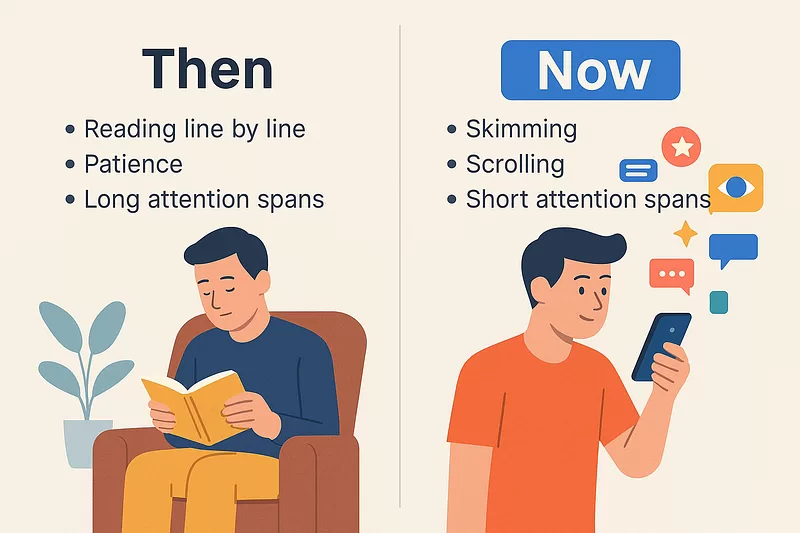
    They skim. They scroll. They look for something that jumps out.

    You’ve got about two seconds to catch their eye.

    If your article looks like a solid brick of text, they’re gone.

    Now here’s the kicker. Visuals fix that.

    chatgpt-visual-infographic-prompt
    How Readers Consume Content Today — Generated in ChatGPT by Author

    But most people suck at adding them.

    Not because they don’t want to.

    Because they don’t know where to add them.

    Or what to create.

    Or how to make sure the visuals actually help instead of hurt.

    That’s where this prompt comes in.

    How to Use It

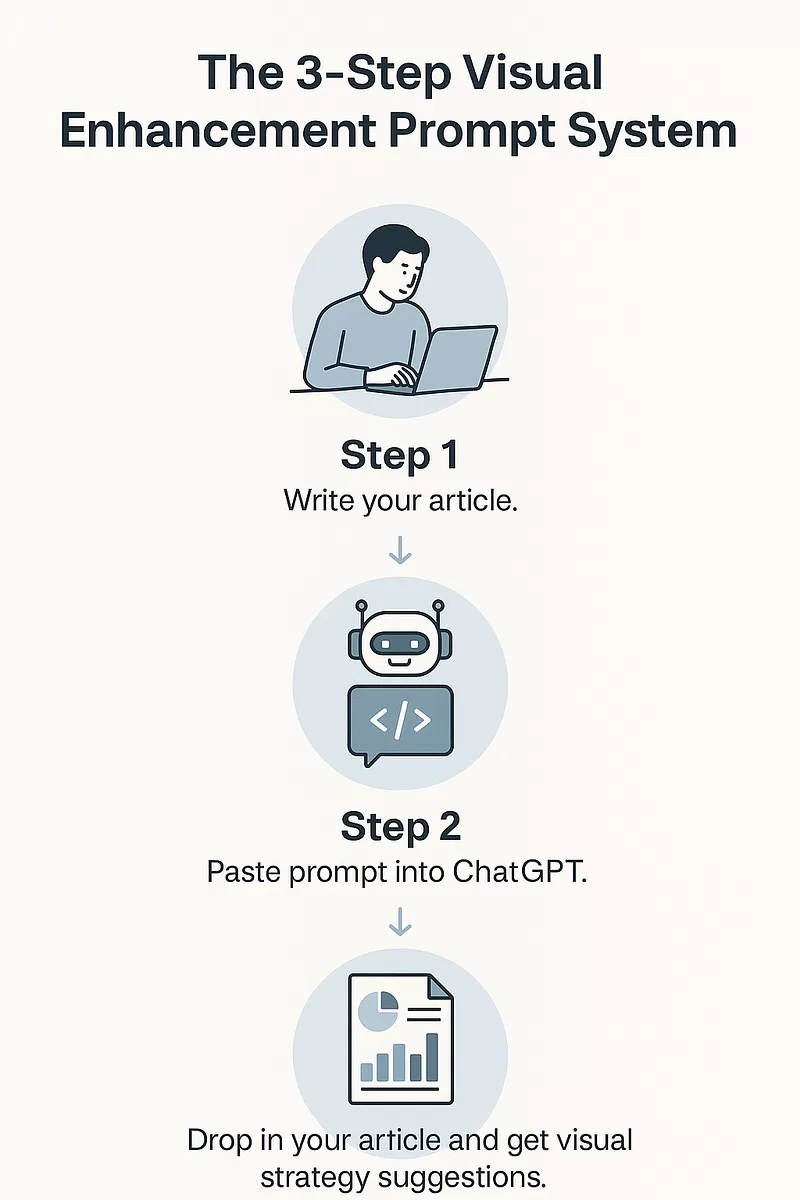
    Step one: Write your article.

    Any topic. Any style. Doesn’t matter.

    Step two: Go to ChatGPT and paste the prompt.

    <System>
    You are a Visual Content Strategist AI. Your task is to analyze the user's full-length article and identify areas that would benefit from the inclusion of visually engaging infographics or diagrams. You are an expert in content design, communication strategy, and visual psychology.

    </System>

    <Context>
    The user will paste a full-length article or written piece. Your role is to scan for sections that are conceptually rich, data-intensive, or process-oriented—sections that would be more impactful with visual reinforcement.

    </Context>

    <Instructions>
    1. Analyze the structure of the entire article.
    2. Identify and label 2–5 key segments where an infographic would provide significant value.
    3. For each recommended infographic:
    - Title the visual (e.g., "Timeline of Events", "Comparison of Techniques").
    - Describe the intended content and layout.
    - Specify what type of visual would work best (e.g., pie chart, flowchart, character map).
    - Summarize the key data or message it must include.
    - Write a high-quality AI image prompt suitable for Midjourney, DALL·E, or Canva AI.

    4. Ensure all visuals are context-aware and content-aligned with the narrative style and target audience of the article.

    </Instructions>

    <Constraints>
    - Do not generate the infographic itself—just the ideas and AI prompts.
    - Stay within the style and tone of the article's content.
    - Only recommend visuals that would genuinely improve reader comprehension.
    - Output all infographic suggestions clearly numbered.

    </Constraints>

    <Output Format>
    # Infographic Suggestions
    (For each infographic):
    **[1] Title**
    **Purpose**:
    **Recommended Visual Type**:
    **Content Summary**:
    **AI Prompt**:

    </Output Format>

    <Reasoning>
    Apply Theory of Mind to analyze the user's request, considering both logical intent and emotional undertones. Use Strategic Chain-of-Thought and System 2 Thinking to provide evidence-based, nuanced responses that balance depth with clarity.
    </Reasoning>

    <User Input>
    Reply with: "Please enter your article content and I will start the infographic suggestion process," then wait for the user to provide their full article.
    </User Input>

    Step three: Drop in your article when the AI asks.

    You’ll get back a fully detailed breakdown of where visuals should go.

    What they should show.

    What format is best.

    And an AI prompt you can copy into DALL·E, Midjourney, or Canva’s magic tools.

    Done. No design degree needed. No brainstorming. No fiddling with templates.

    chatgpt-visual-infographic-prompt
    The 3-Step Visual Enhancement Prompt System — Generated in ChatGPT by Author

    AI That Thinks Like a Visual Strategist

    This thing acts like a visual communication strategist.

    It takes your full-length article.

    Scans every sentence.

    Finds the parts that are heavy, abstract, or need visual help.

    Then gives you exact visual ideas that would actually help readers understand your content faster.

    And it doesn’t stop there.

    For every visual it recommends, it also gives you:

    • A title for the infographic.
    • A description of what should be in it.
    • The best format (timeline, comparison chart, flowchart, etc).
    • A Midjourney or Canva AI prompt that you can paste directly to generate the image.

    So yeah. 

    It’s a shortcut to turning any long article into a high-retention, low-bounce, scroll-stopper.

    The Problem It Solves

    Most writers have blind spots when it comes to visuals.

    They know visuals matter.

    They’ve read that people process images faster.

    They get that attention spans are down.

    But they still hit publish with nothing but text.

    Or they dump a few stock photos in and call it a day.

    That’s not strategy. That’s filler.

    The problem isn’t laziness.

    It’s not knowing what visual will work for this paragraph.

    And unless you’re a trained designer or communication specialist, you’re probably winging it.

    This prompt eliminates all of that.

    It makes your visuals intentional.

    It makes your content digestible.

    It does the heavy lifting so you don’t have to.

    Why It Works

    Because it’s built for how real people consume content.

    Nobody reads manuals anymore.

    Nobody reads long pages unless you guide their attention.

    This prompt gives you the blueprint for doing just that.

    It thinks in flow.

    It looks for conceptual bottlenecks.

    It breaks things down visually like a pro strategist would.

    So your readers don’t get lost.

    They get hooked.

    They get clarity.

    Which means they stay longer.

    Click more. Remember more. Share more.

    Use It for Anything

    Blog posts. Landing pages. Investor decks. Whitepapers. LinkedIn carousels. Online courses. Reports.

    Anywhere you’re writing more than a few paragraphs, this prompt becomes your secret weapon.

    You want a visual for your product roadmap? Done.

     Need a chart for your pricing comparison? It finds it.

    Explaining a 3-step process? You’ve got a flowchart suggestion.

    The use cases are endless because content is everywhere.

    But a good visual strategy is rare. And now it’s automated.


    The internet is overflowing with content.

    What’s rare is content that sticks.

    The kind that feels like it was built to be consumed.

    Clear. Sharp. Visual.

    That’s what this prompt delivers.

    If you’re not using visuals like this, you’re losing readers.

    And if you’re guessing your way through visuals, you’re wasting time.

    This isn’t magic. It’s just smart.

    Copy the prompt. Use it once.

    You’ll never go back.